Search this Blog by Country, Place or Artist

Showing posts with label Zimmermann (Johann Baptist). Show all posts

Thursday, 25 February 2021

Ottobeuren


By Diego Delso, CC BY-SA 4.0, https://commons.wikimedia.org/w/index.php?curid=93730681

Ottobeuren has a special place in my affections. On Sunday 17 August 1969 at 3.00 pm my friend Keith and I were to have heard Schubert's Unfinished Symphony and Bruckner's 7th Symphony with the Vienna Symphony Orchestra there under Josef Krips. It never happened because we had to change the holiday dates! The prebooked tickets were returned and money back. I have still got the paperwork.
I was a Bruckner/Mahler fanatic for many years, well before the surge of interest in the UK. I often wonder what Bruckner 7 would have sounded like in the basilica at Ottobeuren. Perhaps the performance of a lifetime. Never mind, I heard all the great Brucknerians later in London. Eugen Jochum was my great favourite. Anyway enough of that : I never got to Ottobeuren until March 1989. I had no idea that the abbey was part of the experience, but I knew all about the organs and heard a little of those. It was imperative to go back and take a more leisurely look in August 2019 just over 50 years later!

Ottobeuren in 1766


Ottobeuren is one of the most famous Baroque abbey churches in Germany. The whole complex of convent and church has been described as the Swabian Escorial. It would be better to think of the whole complex as a cross with the church as the bent head of Christ, the domestic buildings as the legs, the  monastery as the trunk, administration the right hand and hospitality the left hand.

Ottobeuren was founded in 764 as a Benedictine foundation and grew to become an Imperial abbey in 1299. Disastrous fires and loss of sovereign power to the Archbishop of Augsburg, plus damage in the Thirty Years War meant that it had a chequered history until 1710. The reign of Abbot Rupert Ness (1710-40) ushered in the great period and this lasted until the dissolution in 1802. Ness set about rebuilding the abbey 1711-25 and the church in 1737.  The latter was finished by his successor Anselm Erb in 1766.

I do not intend to go into the building history. Suffice it to say that JM Fischer did not design all the abbey or church but did play a crucial part in the planning and execution of the church. It is a basilica  wall pillar church with two bay nave, developed absidal transepts, with a conical roof over the crossing, two bay square ended choir and twin towered facade. Comparison with Salzburg Cathedral and Weingarten is interesting. The   exterior .to me is noble and imposing and unusual in that it protrudes from the monastic complex.

The interior is overwhelming, a vast open space invigorated by a sea of colour. Yet despite the mass of detail I feel the architecture is not concealed. The form can still be seen through the decoration. The domes are real domes, although not as pronounced as Weingarten or Wiblingen.

The ceiling frescoes by  Johann Jakob Zeiller (1710-83) and Franz Anton Zeiller (1716-94) are outstanding. There is the Trinity and Redemption of Mankind over the high altar, God the Father and 9 choirs of Angels over the Choir, the Coming of the Holy Spirit at Pentecost over the crossing, St Feilicity and her 7 sons and the Stairs of Grace in the transepts Benedic tine heaven over the nave  and Millennial Ottobeuren over the west gallery. The scale and detail of these has escaped me. Several hours with binoculars followed by compulsory neck and back massage was needed.

Stucco work is mainly by Johann Michael Feichtmayer. 

Choir stalls are  by M.Harmann and J.Christian. Most notable are the two organs by the master French organ builder  Karl Josef Riepp (1710-1775)which are built into the choir stalls. This double organ is one of the most treasured historic organs in Europe. It was the main instrument for 200 years, until 1957 when a third organ (Mary organ) was added in the west gallery by G. F. Steinmeyer & Co, renovated and augmented in 2002 by Johannes Klais, making 100 stops available on five manuals plus pedals.


Benedictine heaven by FA and JJ Zeiller

In centre Pentecost cupola fresco by FA and JJ Zeiller


Holy Cross altar and Holy Spirit organ


View to Mary Organ in gallery

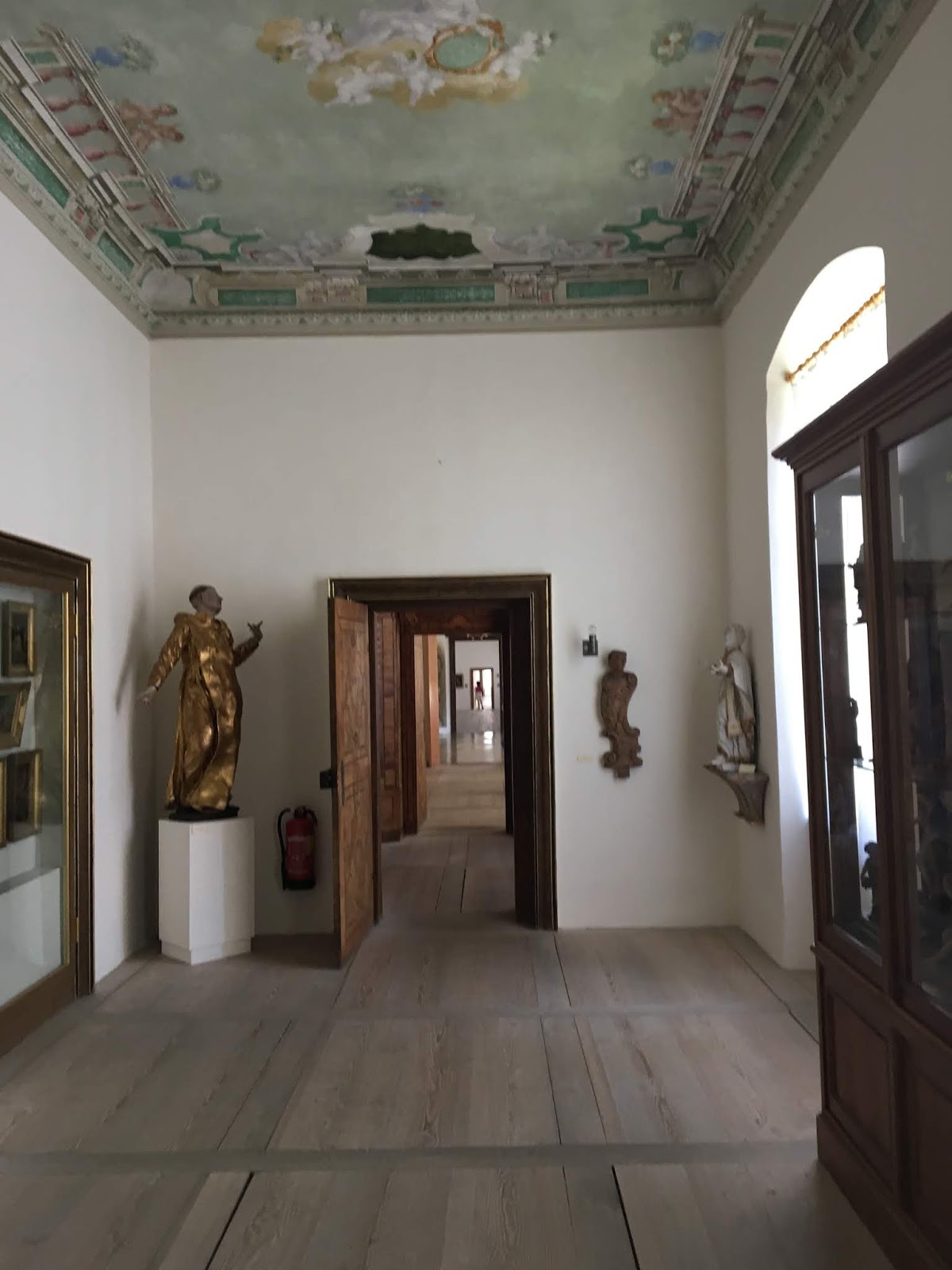
The Museum in the abbey buildings is very large and fascinating.

Grand entrance up to Abbey museum

Corridor to the Abbot's suite of rooms
Ceiling above entrance staircase

Franz Anton Zeiller , brother of Johann Jakob,
creator of the ceiling frescos
P. Ulrich Schiegg, (1752-1810)mathematician and astronomer
Model : Presumably Ulrich Schiegg at work


Library corridor


Library by JB Zimmermann 1718
Library


Ornamental stove
Doorway into Abbot's quarters


Fireplace in Abbot's  quarters

Abbot's reception room
Abbot's living room or Eustachiuszimmer

Apothecary

Schreibschrank  or writing cupboard or bureau
Last supper

Museum corridor


Abbot's chapel

Abbot's chapel

Ceiling of the Theatre

Theatre ; unfortunately full of exhibition items


Kaisersaal
Kaisersaal


Ceiling of the Kaisersaal :Coronation of Emperor Charlemagne by the Pope.

Ceiling of main staircase leading to Kaisersaal


Staircase to Kaisersaal


Die Wies


Taking up the story of my first visit (see Steingaden) I arrived before 8.00am outside the church. No-one was about and the doors firmly shut. It was enough to have seen and touched it, I concluded, so I went back the way I had come and reached Mittenwald in mid afternoon.

 The next time I saw die Wies was in the early 1990s when I was passing through the area with my then young son. I drove up to it, saw no chance of parking, or being able to appreciate it that day, so instead I parked it in my brain. It was therefore a great joy to include it in My Holiday of a Lifetime jaunt in August 1989.

In 1730 Father Magnus Straub and Friar Lukas Schwaiger created a Flagellated Saviour figure from wooden portions of other saints' figures. They covered the joints with canvas and painted the figure. It did not go down too well and was  put away from 1734-8 and kept in a garret  by Steingaden innkeeper Jeremias Rehle.. His godmather Mary Lory, took it to her farm at Wies. During prayers on 14 June 1738 tears were seen to come from the statue. This led to Wies becoming a pilgrimage centre. People came from Bohemia, Moravia, Tirol and Switzerland. A small chapel was erected in 1740 and then a small wooden nave. The Abbot of Steingaden commissioned a church. Dominikus Zimmermann then created what has been called the greatest rococo church in the world. He was a strong believer, and this inspired his work.This church is today not just great art or a kind of music hall or like Dresden china but a pilgrimage centre to revive us. The foundation stone was laid in 1746 and consecrated 1749.

It is oval with a rectangular choir. There is an aisle all around the church  with a lofty arcade that supports a dome. Light can stream in from the clear glass windows in the outer walls through the arcades. The junction between the arcade and the ceiling is important and can give the impression there is no ceiling at all. In paint and stucco a kind of balustrade is formed, behind which clouds and angels can float as from the roof.

What are we to make of JB Zimmermann's frescoes? When in the church it is hard to take in the detail. I cannot pretend to have grasped the subtleties then, and now on reflection realise this needed time, diagrammatic plans and excellent photos in order to appreciate. I am in awe of the compositional skill, imagination and inspiration of this remarkable man. Perhaps this will be a future project and interest. I have noticed that books, and articles tend to see frescoes as art objects, rather than concentrating on their subject matter and message. Sometimes Wiki Commons images give every possible detail about the technical side of the photo but tell only the place taken, and no detail of title of the fresco.

With the help of a guide book I will attempt to explain the huge central fresco. As we enter the church  the fresco shows the salvation of the world through Jesus Christ : angels, and saints waiting to sit in judgement. It is to be seen less as a Day of Judgement with wrath and tears and more as a manifestation of Our Lord's mercy, achieved through repentance. Note the judgement throne is unoccupied What a  contrast with Michelangelo's Christ in the Sistine Chapel where Christ is like a warrior. 

Overall view of the central fresco
https://commons.wikimedia.org/wiki/File:Wieskirche_1.12.jpg#/media/File:Wieskirche_1.12.jpg

As we leave the church the other side of the fresco  above the door is the Door to Eternity so we have both the door to the world and to eternity. This  latter door is closed. Chronos, the old Greek God of Time looks old and his scythe has dropped, the hour glass is on the ground; to the left the waters of eternity begin to flow, for the Angel of Judgement is coming, and other angels have the trumpets of judgement. Words above the door say "Tempus non erit amplius" or "There shall be delay no longer"(Apocalyse 10 :6) The departing pilgrim sees the mountains, meadows, all green and beautiful, then looks up and is reminded that when the door of eternity opens to the faithful, their share will, by a single glance into the beauties of eternal life, be beauty beyond parallel.


Our first view

Organ gallery over entrance door


Pulpit

The high altar contains the statue of  the Flagellated Christ. The saving act of Christ is central to this Church Above the figure of Christ is a statue of a pelican - tearing its breast to feed its young. The frescoes above emphasise the sacrifice of Christ and connects to the sacrifice which is repeated every time Mass is given below.

The ceiling frescoes over  the choir passages show Christ  helping people bodily : healing, casting out evil spirits, raising the dead.

The large statues of the four Fathers of the Church are by Anton Sturm.

Pews, pulpit and organ case are all superb .It is likely that D Zimmermann designed it himself and his Wessorunnb craftsmen stuccoed it.

Choir looking up to high altar. Note modern altar on left trying to be as
inconspictuous as possible!


View into ceiling over choir toward high altar


St Ambrose
St Gregory

St Jerome
St Augustine